Semantic Atoms for Scalable Text Analysis in Data Analytics in the Era of LLM-Based Agents
Modern tables mix text with structured columns, and LLM agents now drive the analysis. TADA asks the systems question underneath: when the executor already controls a symbolic runtime, what semantic interface should the data system expose?
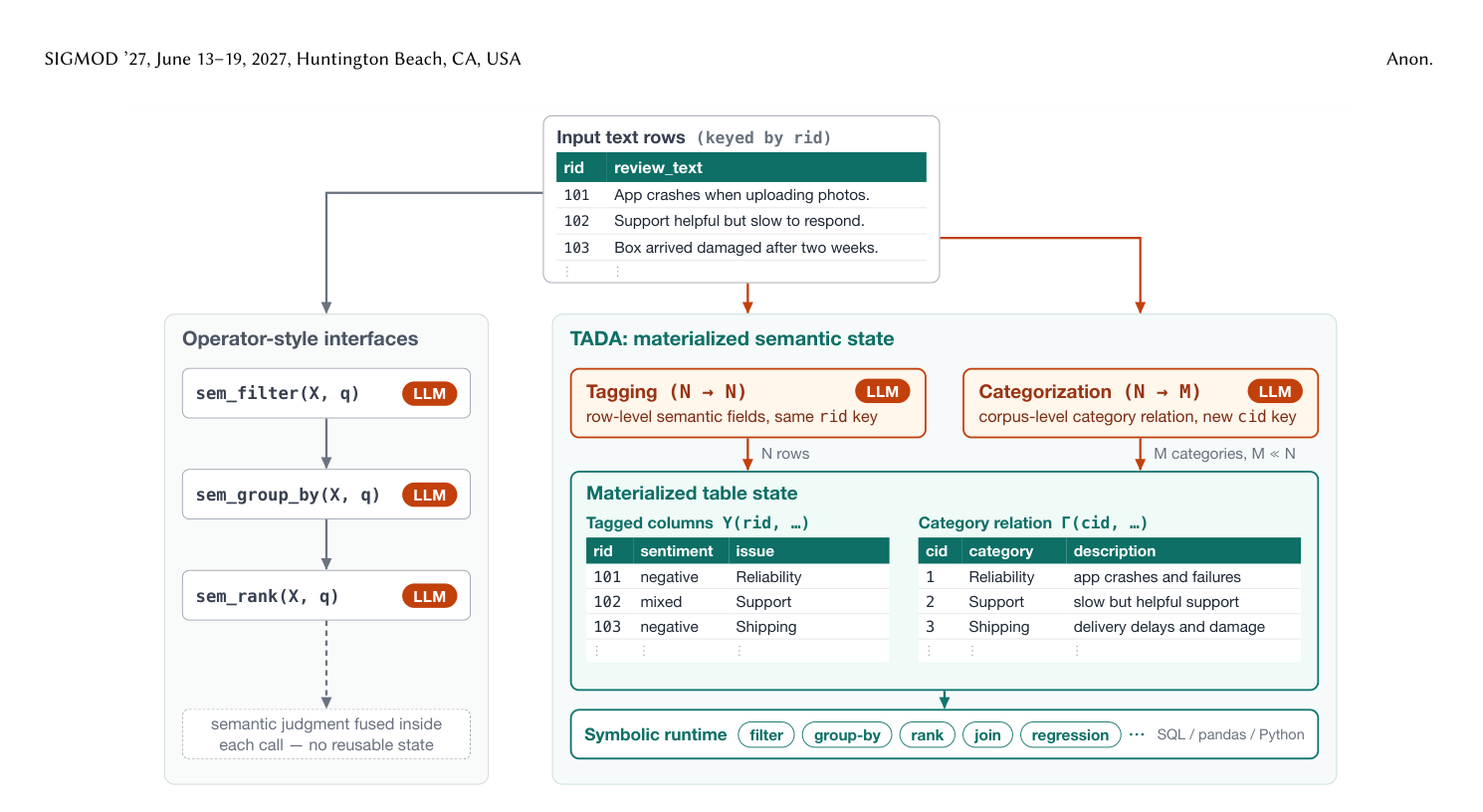
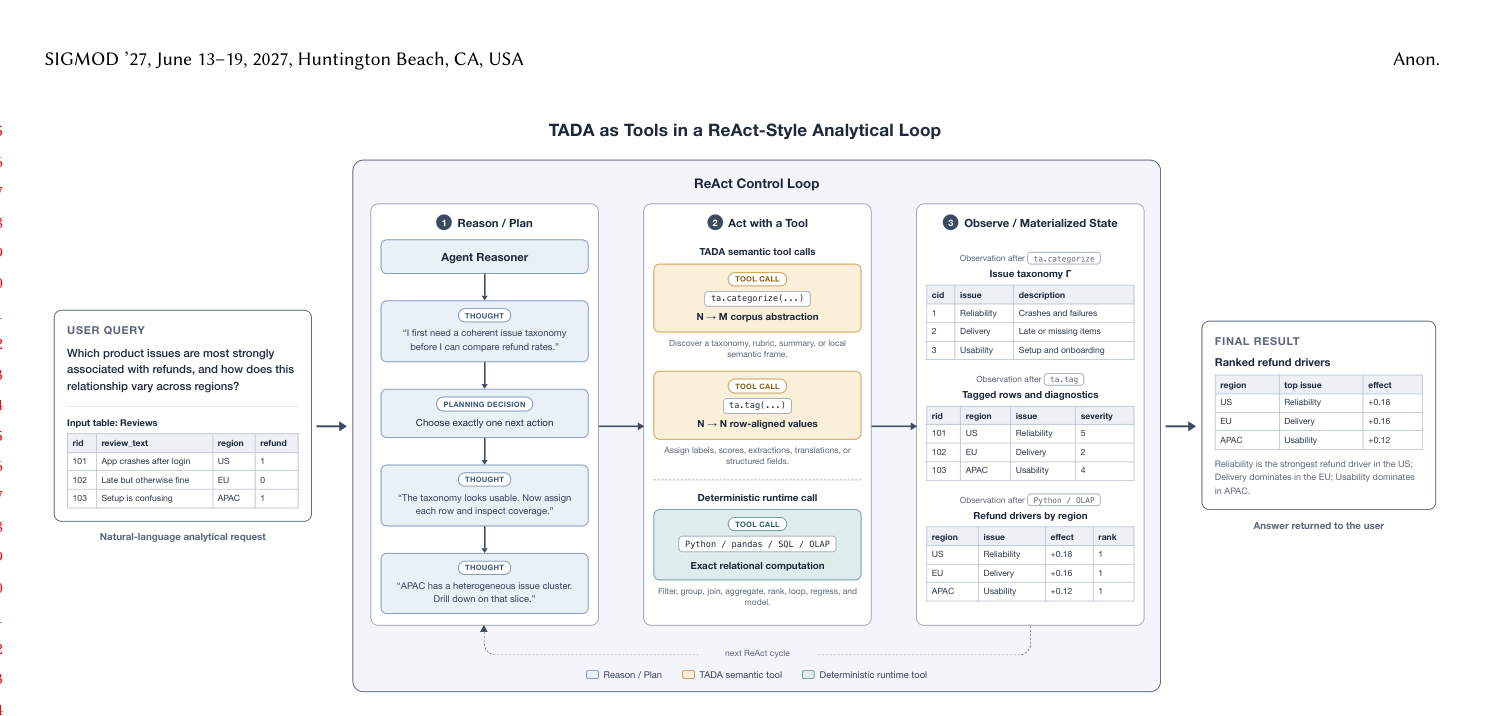
TADA proposes a finer boundary built on two semantic atoms over text columns. Tagging is an N→N operation producing typed, row-aligned fields keyed by row id. Categorization is an N→M corpus-level operation creating a detached relation of discovered abstractions. Both outputs are materialized as ordinary table state — inspectable, reusable, and composable with the full symbolic runtime. The LLM is confined to semantic judgment; everything else stays deterministic.
At corpus scale, a Map–Reduce execution harness lets the same two atoms operate beyond a single reliable context window, with a top-k preservation analysis making the approximation boundary explicit.
Key Contributions
Agent-Facing Abstraction
Text analysis inside analytical programs is formulated as an interface problem: two typed, materialized semantic contracts separate probabilistic judgment from symbolic execution.
Scalable Realization
TADA-Agent implements the abstraction with validated, keyed state materialization and a Map–Reduce harness for bounded-context execution, backed by an analysis of top-k category preservation under partitioning.
Artifact-Backed Evaluation
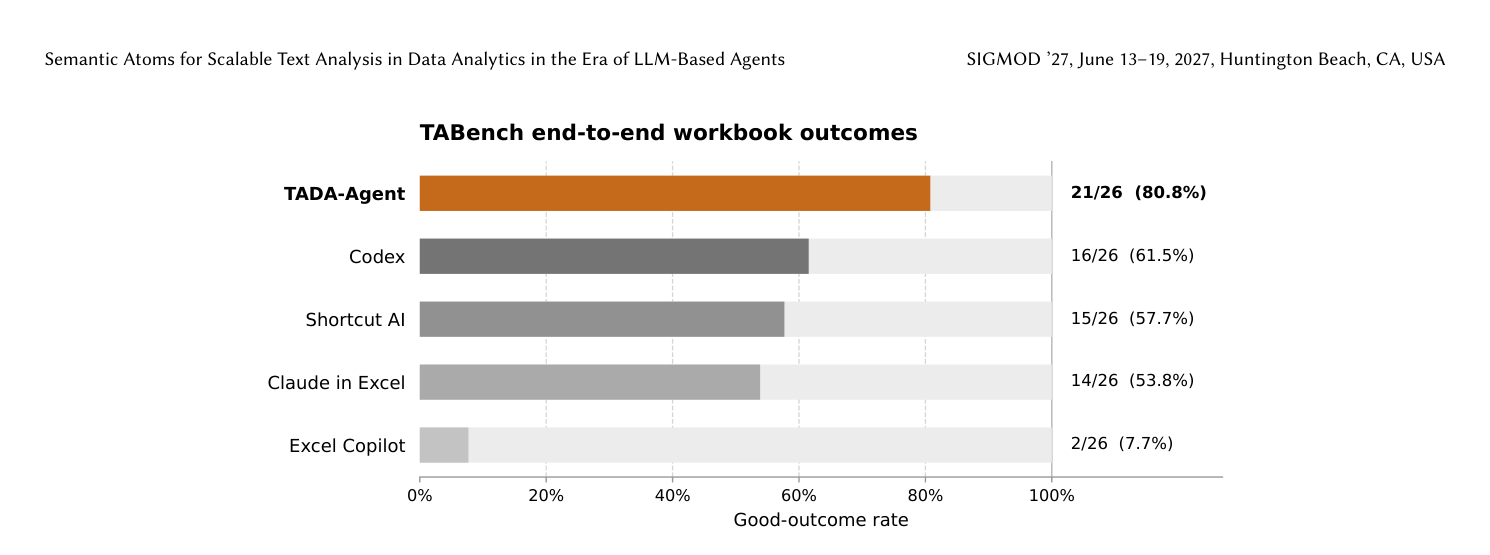
TABench: 26 complete semantic–symbolic workbook requests derived from a literature-grounded taxonomy, probing both the strength and the boundary of the two-atom framework — plus public extraction benchmarks and a scaling study.
Honest Accounting
Missing, unreadable, or protocol-mismatched evidence is retained as limitations rather than converted into favorable scores; repeated runs are distinguished from single-run baselines throughout.
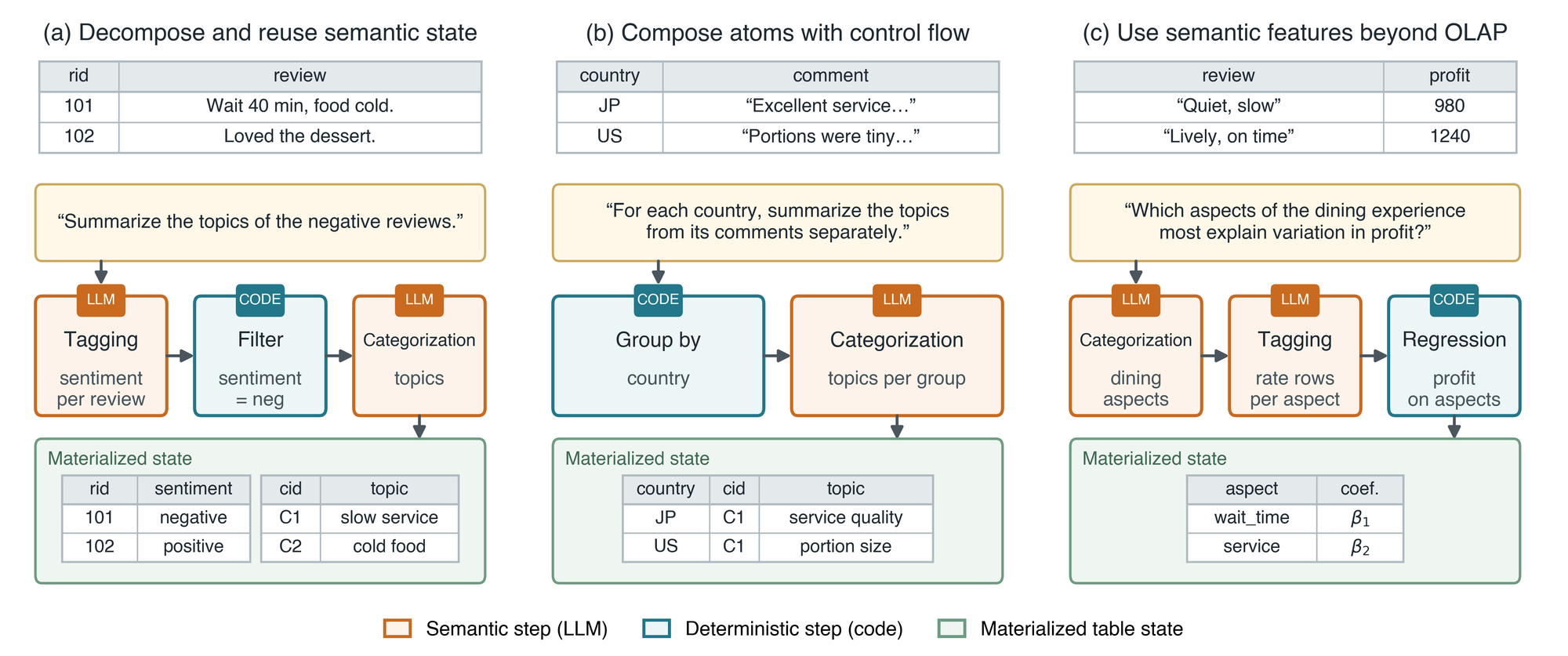
Composing Semantic and Symbolic Steps
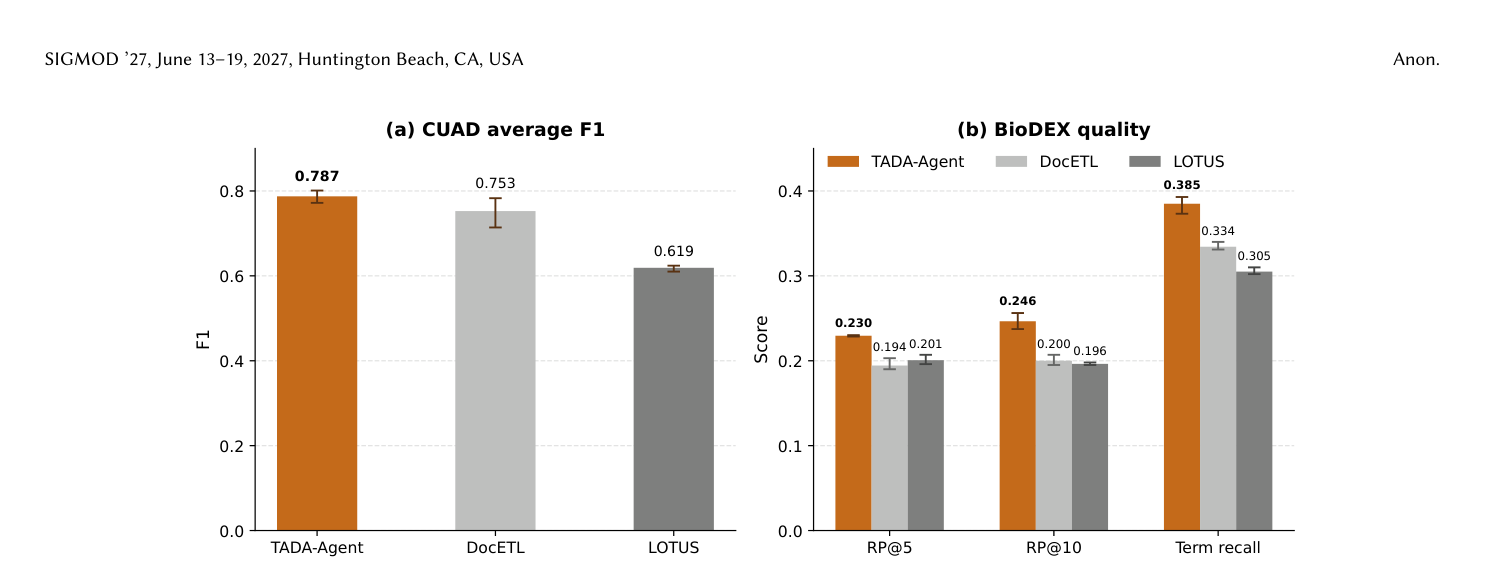
Public Document-Extraction Benchmarks
TABench: End-to-End Workbook Outcomes
Inside the Agent Loop
Scalable Execution
On three approximately 2.6K-row open-vocabulary joint-topic workloads, moving from (n,r) = (60,10) to (500,19) cuts complete-execution LLM calls by 85.3% and wall time by 30.0%, with no observed decrease in the reported global-topic or row-level metrics.
Relation to CAST
The two atoms were introduced in CAST (ACL 2026 Findings) as stable summarization and tagging operations. TADA adopts those implementations and recasts their typed outputs as an agent-facing systems abstraction — proving the compositional properties (sufficiency for scoped TADA workloads, scalable bounded-context execution) that CAST left open.
Status
In submission. A unified cross-system benchmark campaign (all baselines under three-repeat self-consistency with a position-debiased LLM judge and human calibration) is in progress.