DSGram: Dynamic Weighting Sub-Metrics for Grammatical Error Correction in the Era of Large Language Models
Reference-based metrics like BLEU break down on LLM-based GEC systems. DSGram introduces a dynamic-weighting framework with three new sub-metrics that align significantly better with human judgment.
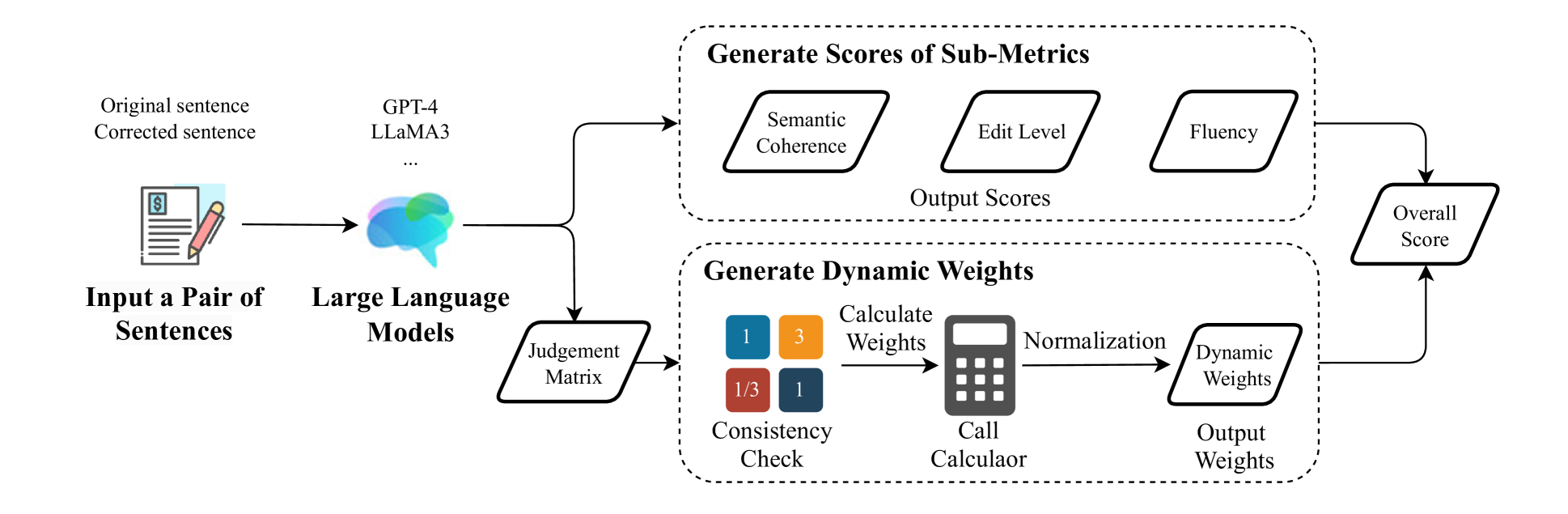
In this study, we propose a novel evaluation framework for GEC models, DSGram, integrating Semantic Coherence, Edit Level, and Fluency, and utilizing a dynamic weighting mechanism. Our framework employs the Analytic Hierarchy Process (AHP) in conjunction with large language models to ascertain the relative importance of various evaluation criteria. Additionally, we develop a dataset incorporating human annotations and LLM-simulated sentences to validate our algorithms and fine-tune more cost-effective models.
Experimental results indicate that our proposed approach enhances the effectiveness of GEC model evaluations.
Motivation
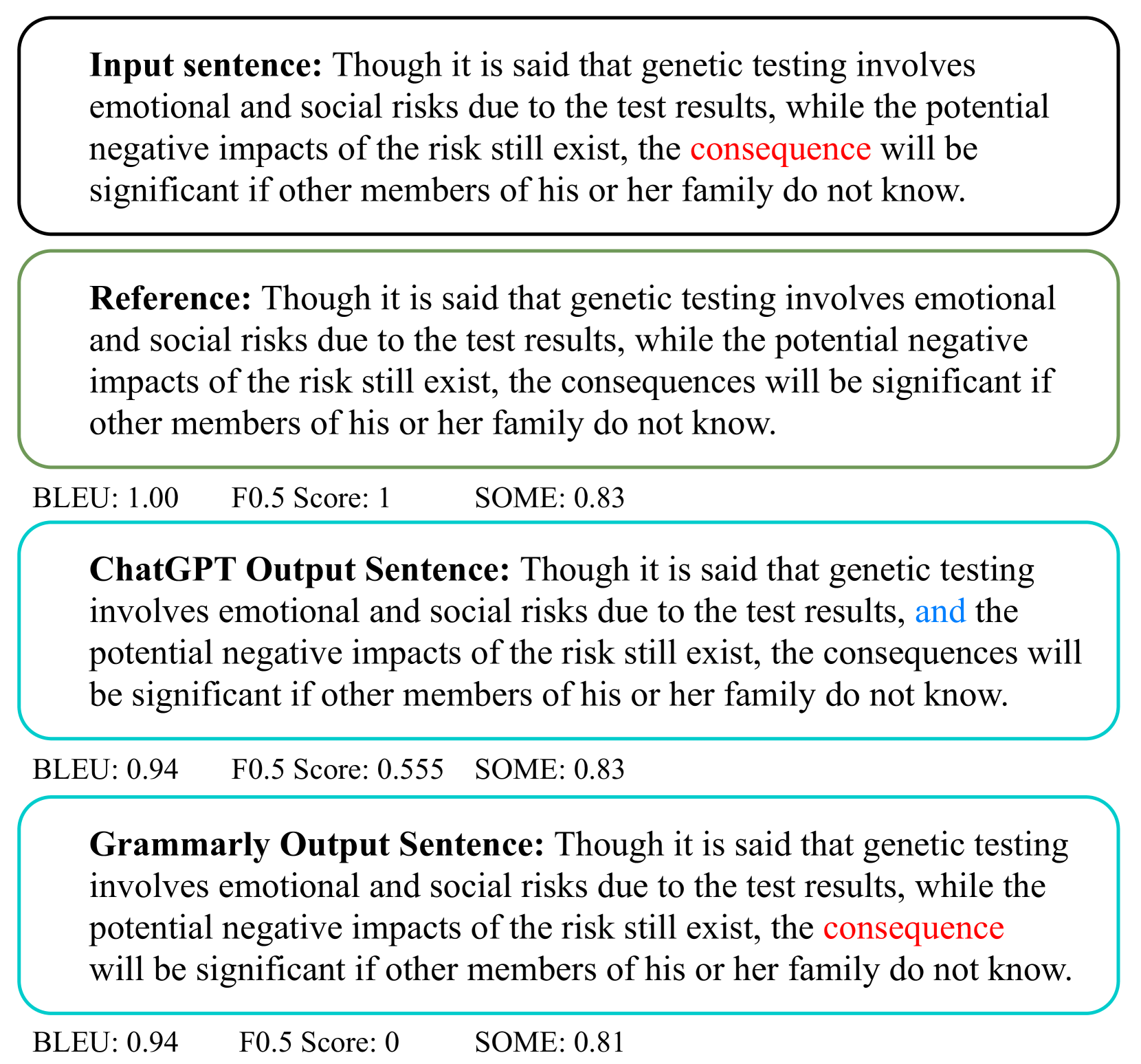
Traditional GEC evaluation metrics have significant limitations when dealing with LLM-based systems. As shown below, BLEU fails to differentiate between over- and under-correction, while SOME cannot capture over-correction. DSGram addresses these gaps with a comprehensive evaluation framework.
Key Contributions
-
01
New Sub-Metrics
We introduce redesigned sub-metrics for GEC evaluation — Semantic Coherence, Edit Level, and Fluency — that address the over-editing problem in LLM-based GEC models.
-
02
Dynamic Weighting with AHP
A novel dynamic weighting method integrating the Analytic Hierarchy Process with LLMs to ascertain the context-dependent importance of evaluation criteria.
-
03
Evaluation Datasets
We release DSGram-Eval (human-annotated) and DSGram-LLMs (GPT-4 simulated), both built on CoNLL-2014 and BEA-2019 test sets for rigorous evaluation.
-
04
Superior Correlation
DSGram achieves higher correlation with human judgments than all conventional reference-based and reference-free metrics on the SEEDA benchmark.
Method
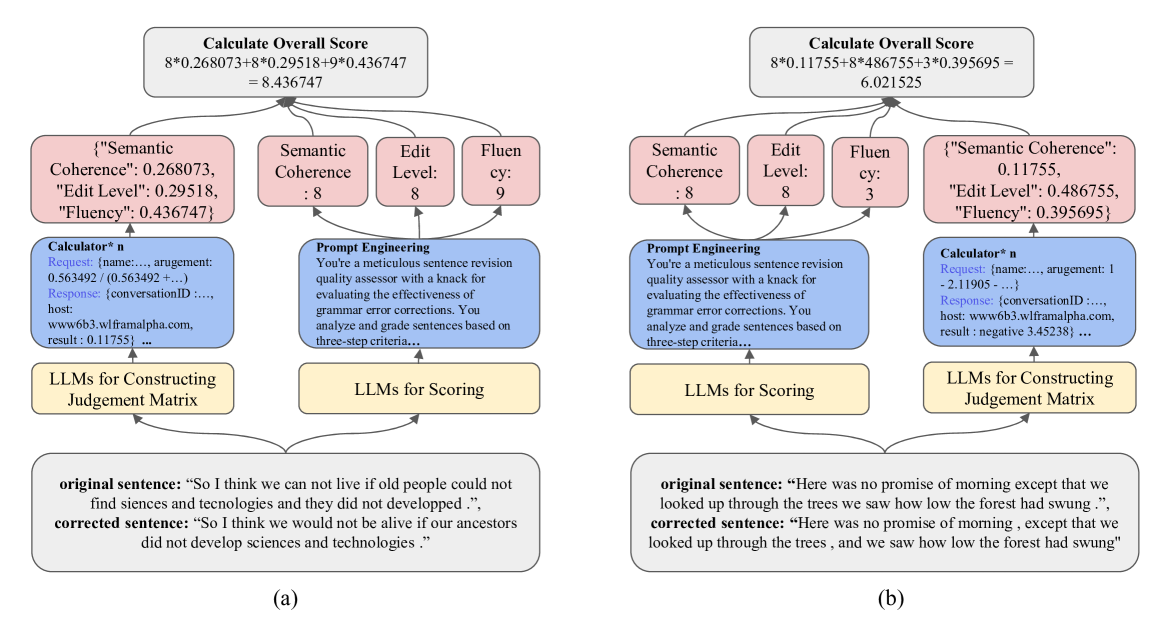
DSGram comprises two main components: score generation and weight generation. By applying context-specific weights to the generated scores, an overall evaluation score is obtained.
Three Sub-Metrics
Semantic Coherence: degree to which original meaning is preserved. Edit Level: whether corrections are necessary and appropriate. Fluency: grammatical correctness and natural flow.
Dynamic Weighting via AHP
Uses LLMs to construct pairwise comparison matrices for each sentence, with consistency checks and eigenvector normalization. Formal texts emphasize Edit Level; casual texts prioritize Fluency.
Sub-Metrics Analysis
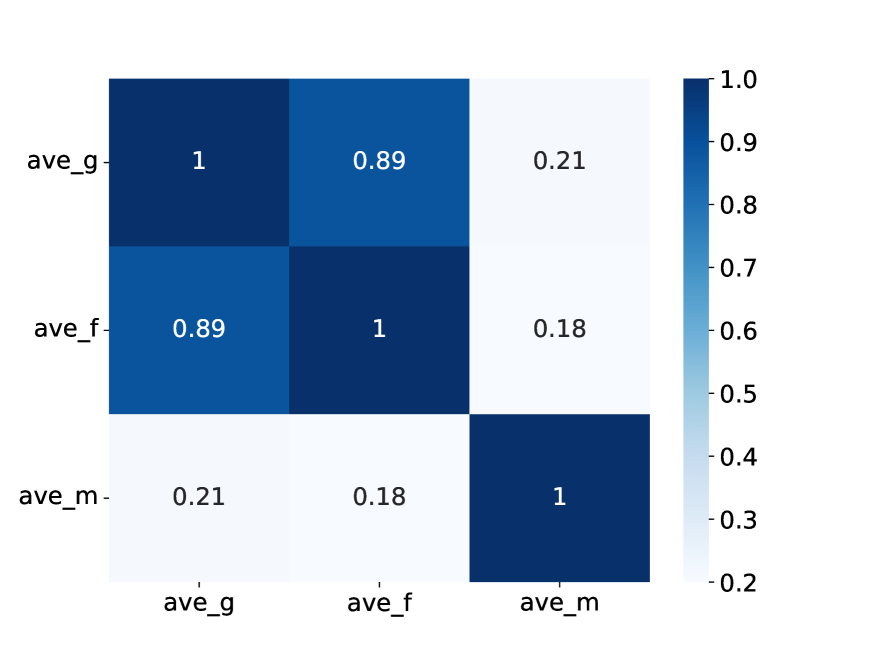
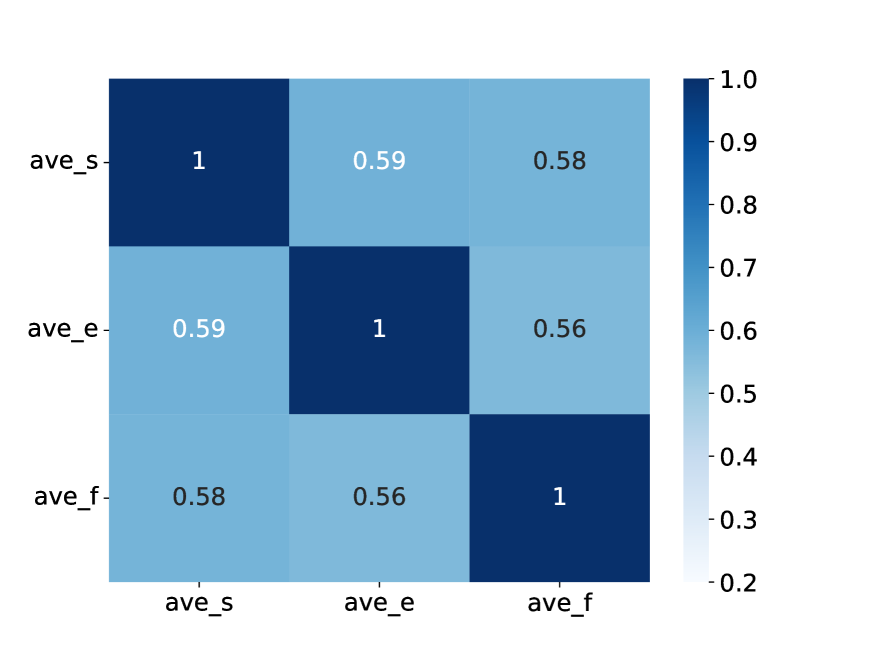
We redesigned the sub-metrics to reduce redundancy and improve coverage. The original SOME metrics showed high correlation (0.89) between Grammaticality and Fluency. Our new sub-metrics achieve a more balanced distribution.
Results
DSGram's correlation with human feedback surpasses all conventional reference-based metrics (M², ERRANT, BLEU) and reference-free metrics (GLEU, Scribendi Score). Fine-tuned LLaMA3-8B and LLaMA2-13B models on DSGram-LLMs dataset also outperform their few-shot counterparts, demonstrating the framework's practicality with cost-effective models.